


Cash, for resiliency when digital payment systems fail
On Monday, October 20, a cloud system disruption cascaded into system outages for point-of-sale (POS) card transactions across Europe and Latin America.
This article examines what happened during the outage, why it matters and how to prepare for similar events in the future.
The issue began that morning in Spain, affecting payment terminals and instant payment services. Reports said the initial root cause was fixed 1:30 PM Spanish time (about 4.5 hours after the incident began), but full system recovery was not competed until after midnight, so intermittent outages and errors continued through the night—for a total of over 15 hours.
A surge in cash withdrawals
When the Oct. 20 outage occurred, most people in Spain couldn’t use digital payments and had no idea when they’d be able to. So what did they do? They went to ATMs and got cash to buy essential items they weren’t able to buy using digital payment systems.
Outages like this one underscore the critical role of ATMs in financial ecosystems and highlight how customer priorities shift during service disruptions. While such massive outages are rare, their impact on consumer behavior can be profound—particularly when multiple outages occur in one place. For example, a sudden power outage in Spain and Portugal on April 28, 2025, paralyzed POS systems for 10 hours—tripling ATM transactions as people turned to cash for essential purchases.
Analyzing these patterns can offer valuable insights for financial institutions seeking to strengthen resilience and customer trust. Such insights can help institutions better prepare for real life events that drive the absolute need for cash and use those moments to create memorable customer experiences.
Cash withdrawals spiked 23% in Spain as consumers sought immediate access to cash when digital payment options weren’t available.
Cash withdrawals spiked 23% in Spain as consumers sought immediate access to cash. (And this was on a Monday, when transaction volumes are typically low.) This surge was not a coincidence. It reflected an immediate need for liquidity among customers who feared prolonged service disruptions.
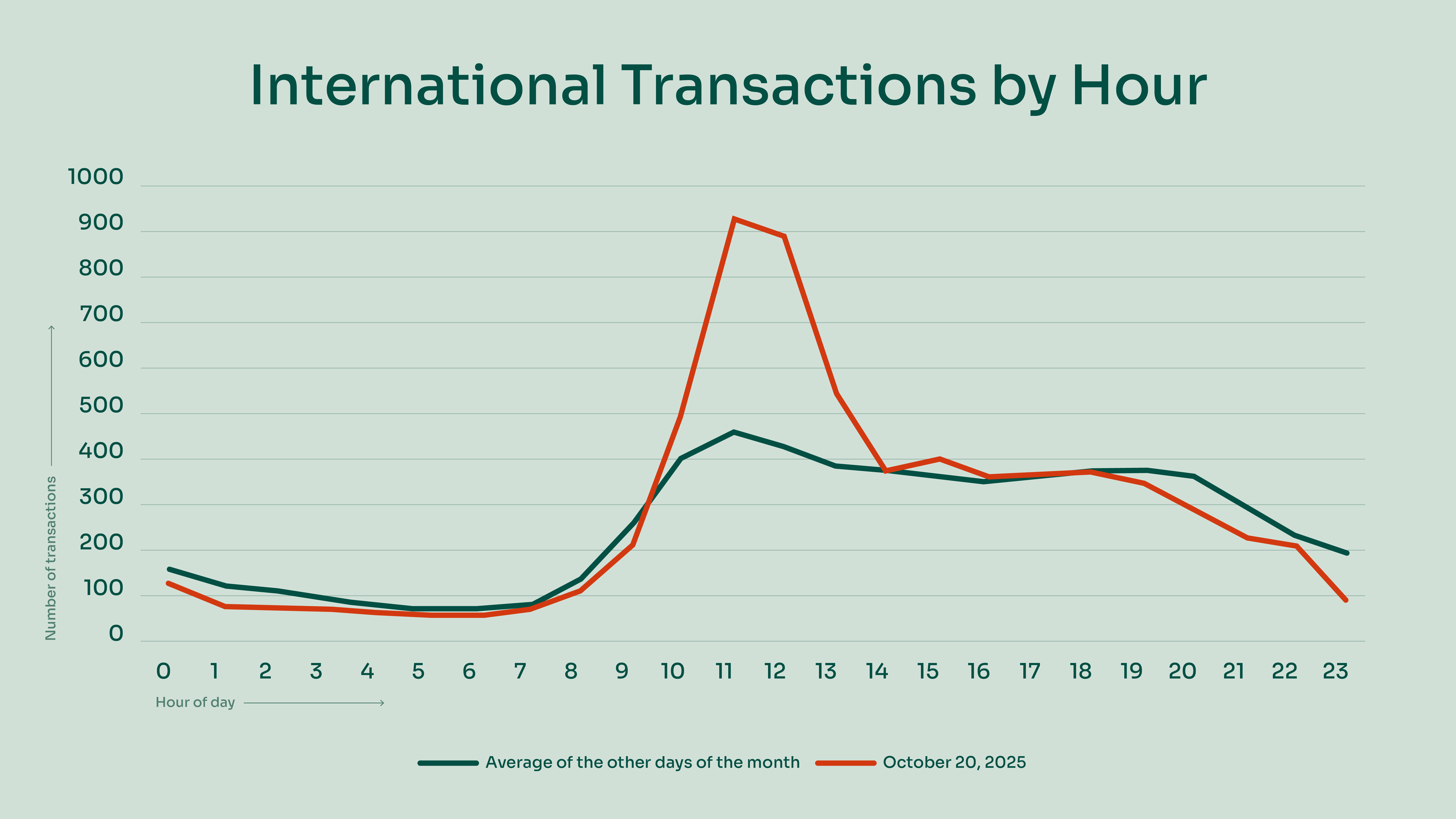
The surge illustrates that, when digital channels falter, cash becomes the fallback, underscoring the enduring importance of physical currency in times of uncertainty. For financial institutions, this behavior highlights the critical role of ATMs as a safety net and the need for robust contingency planning.
Recovery patterns post-outage
Once the outage was resolved, withdrawal volumes gradually normalized over five days, returning to baseline by October 25. This slow recovery indicates that customer anxiety does not dissipate immediately after service restoration. Institutions should anticipate lingering effects and adjust operational strategies accordingly—such as replenishing ATMs more aggressively in the days following an outage and monitoring transaction patterns to prevent shortages.
Operational resilience and customer trust
The October 20 event serves as a reminder that resilience is not just about technology—it’s about customer experience. Outages can erode trust quickly, especially if communication is unclear or delayed. Financial institutions should invest in proactive messaging systems that inform customers about the nature of disruptions, reassuring them about systems recovery, expected timelines for resolution and available alternatives. Transparency during crises can mitigate panic-driven behaviors like mass withdrawals and reinforce confidence in the institution.
Predictive modeling for demand surges
Data from this outage offers a valuable opportunity for predictive analytics. By analyzing transaction spikes during service interruptions, financial institutions can develop models to forecast demand surges under similar conditions. These models can guide ATM cash replenishment strategies, ensuring that machines remain stocked even when usage patterns deviate sharply from the norm. Predictive insights can also inform staffing decisions, helping financial institutions allocate resources efficiently during high-stress periods.
Implications for digital transformation
While the outage underscores the resilience of cash, it also raises questions about digital dependency. As financial services become increasingly digital, outages—whether due to technical failures or cyberattacks—pose systemic risks. In such times, physical payments—cash payments—are the only way to keep the economy up and running. Institutions must balance innovation with reliability, ensuring that digital platforms are supported by robust backup systems. Hybrid strategies that integrate physical and digital channels can provide customers with confidence that their funds will remain accessible under any circumstances.
Building a customer-centric response framework
Ultimately, the lesson from October 20 is clear: outages are inevitable, but their impact can be managed. A customer-centric response framework should include:
Real-time communication. Automated alerts via SMS, email and app notifications.
Alternative access points. Partnerships with retailers or other financial institutions to provide emergency cash access.
Post-outage engagement. Follow-up messages reassuring customers and offering support for any lingering issues.
Conclusion
The October 20 outage was a stress test for Spain’s ATM network and a case study in consumer behavior under pressure. The 23% spike in withdrawals, stable deposit activity and gradual recovery all point to the enduring importance of cash access and the need for operational resilience. For financial institutions, the takeaway is simple: prepare for the unexpected, communicate transparently and leverage data to anticipate customer needs. By doing so, institutions can turn moments of disruption into opportunities to strengthen trust and loyalty.



Let’s explore what’s possible for your business. Our team is ready to connect and discuss tailored solutions that meet your goals.
Thank you for reaching out. A member of our team will be in touch shortly to continue the conversation.